

Eland Hull Development
We have invested significant time and effort into the Eland hull form to develop a hull which provides good seakeeping, a dry ride and sufficient deck space to offer a good working area for any commercial user.
The hull was developed utilising extensive experience with a range of hull forms from luxury tenders to military sea boats and high-speed interceptors. Input from experienced coxswains operating a range of vessels in varying operational environments was invaluable, and every conversation held added another important feature, no matter how small the adjustment was.
The first step was the concept, a pencil sketch on a notepad during a brainstorming session which was the beginning of a long process. Using pencil, lines can be corrected, erased and redrawn with ease.


Once the overall lines plan concepts were completed, the design was transferred into a 3D modelling program where the hull was modelled, faired, checked and amended until the form looked good. Along the way, the design was backed up with calculations to ensure the vessel would perform as expected.
.jpeg)
But no design can even be completely finished by looking at a screen and crunching numbers. A 3D printer allowed us to print variations of the hull and analyse the hull form on a 3D object which can be manhandled. Further modifications were made to the hull form until one was selected for further testing.
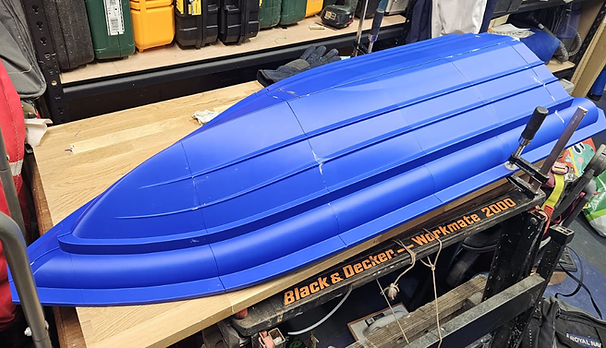
This hull form was printed in several sections on the 3D printer before being bonded together to produce a test model at a scale of 1:7. The surface was faired, a plug gelcoat applied, faired, gelcoat reapplied, faired and finally polished to a high gloss. What is written in a few words took a long time to fair the surface sufficiently to allow a mould to be made.

With the plug fully prepared, polished, and carefully waxed to ensure a high-quality release surface, a mould was produced directly from the hull. Once the moulding process had been completed and the composite materials fully cured, the mould was carefully demoulded from the plug, creating a precise and durable tooling surface ready for future hull production.
Model Hull Build

Once demoulded, the hull mould underwent further refinement to ensure the highest possible production quality. Minor surface imperfections and defects were carefully corrected before the mould was progressively polished to achieve a smooth, high-gloss finish. This stage is essential in producing clean, accurate composite components and ensuring the final hull maintains both structural integrity and a high standard of finish.
With the mould preparation complete, the next stage is the construction of the model itself using lightweight carbon fibre materials. The vessel will then be fitted with propulsion systems, remote control equipment, and a range of onboard data recording instruments designed to capture and monitor key performance information during testing. These systems will record data including RPM, GPS speed, roll and pitch accelerations, handling characteristics, and additional operational metrics, allowing the team to analyse performance in detail and further refine the vessel's capabilities.

Once the model is completed, testing can be conducted. Stay tuned for further updates!
Our hulls have been carefully and skillfully designed by the naval architects of Boland Marine. To learn more, please use the button below.